Defining Sleep Cycle’s path into sleep apnea
Defining the foundations for a sleep apnea experience by balancing user needs, scientific validity, regulatory considerations, and product strategy
Product Design
Strategy
Service Design
Research
App

Sleep Cycle engaged us in the early exploration of sleep apnea: a highly sensitive and regulated health domain at the intersection of consumer wellness and clinical responsibility.
Working closely with researchers, stakeholders and product leadership, I helped shape how Sleep Cycle could approach sleep apnea screening, insights, and user guidance within the constraints of scientific validity, regulatory considerations, and product strategy.

Client | Sleep Cycle |
Industry | HealthTech, SleepTech |
Timeline | 2024 - 2025, 7 months |
My Role | Product & Service Designer. |
Team | 2 Product & Service designers, 1 Visual Designer, 1 Copywriter, Sleep Cycle’s Head of Product, Head of Sleep Science, and stakeholders+. |
Case | NDA-limited overview. Visuals and details have been simplified or abstracted. |
Context
This project explored how a consumer health product can introduce an AI-based screening for potential sleep apnea in a way that is clear, responsible, and trustworthy.
The challenge sits between consumer UX, medical uncertainty, and regulatory constraints - where the experience needs to remain simple and calm while handling sensitive, non-deterministic health signals.
My role focused on shaping the end-to-end system: onboarding into screening, interpretation of results, and follow-up paths including reporting and longer-term engagement.
“Hannah was instrumental throughout the work, from competitor and market analysis to concrete product solutions and UX execution. She was attentive to what Sleep Cycle was as a company, while at the same time constructively challenging us on what we should do to reach a new audience.”
Andreas Roman
Former Head of Product, Sleep Cycle

The challenge
Sleep apnea is widely underdiagnosed, but difficult to detect without clinical tools. Introducing screening in a consumer product creates a core tension:
How do you communicate uncertainty without losing trust - or overpromising clarity?
The experience needed to balance the following: 1. Medical ambiguity and user understanding, 2. Regulatory constraints and product usability, and 3. Trust, safety, and product engagement. At the same time, it had to fit into an existing product ecosystem with established expectations.
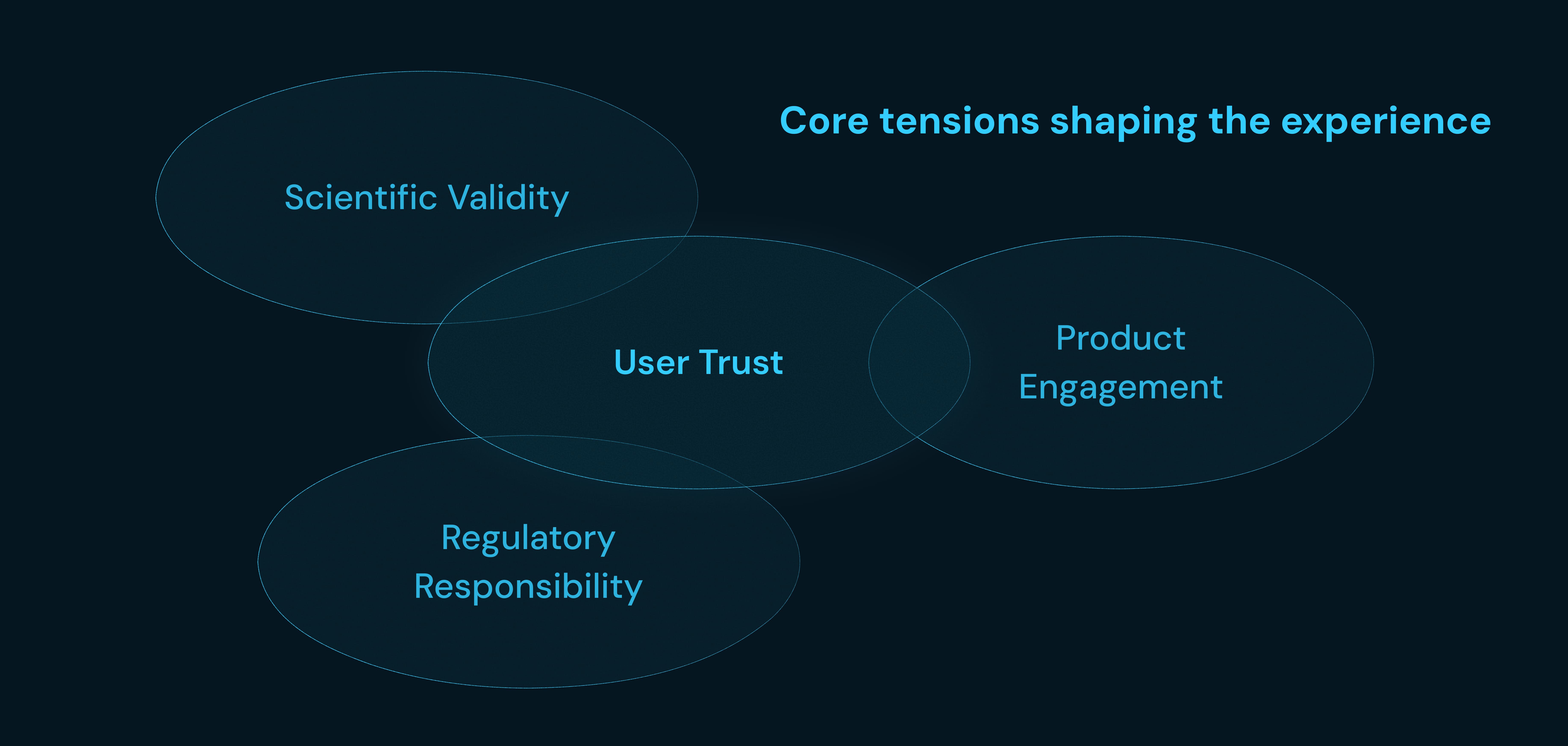
Beyond the screening experience itself, the project also explored broader questions around education, engagement and value creation. Many users may be unfamiliar with sleep apnea altogether, requiring the product to balance awareness, motivation and action without creating unnecessary anxiety.
Exploring multiple paths before committing
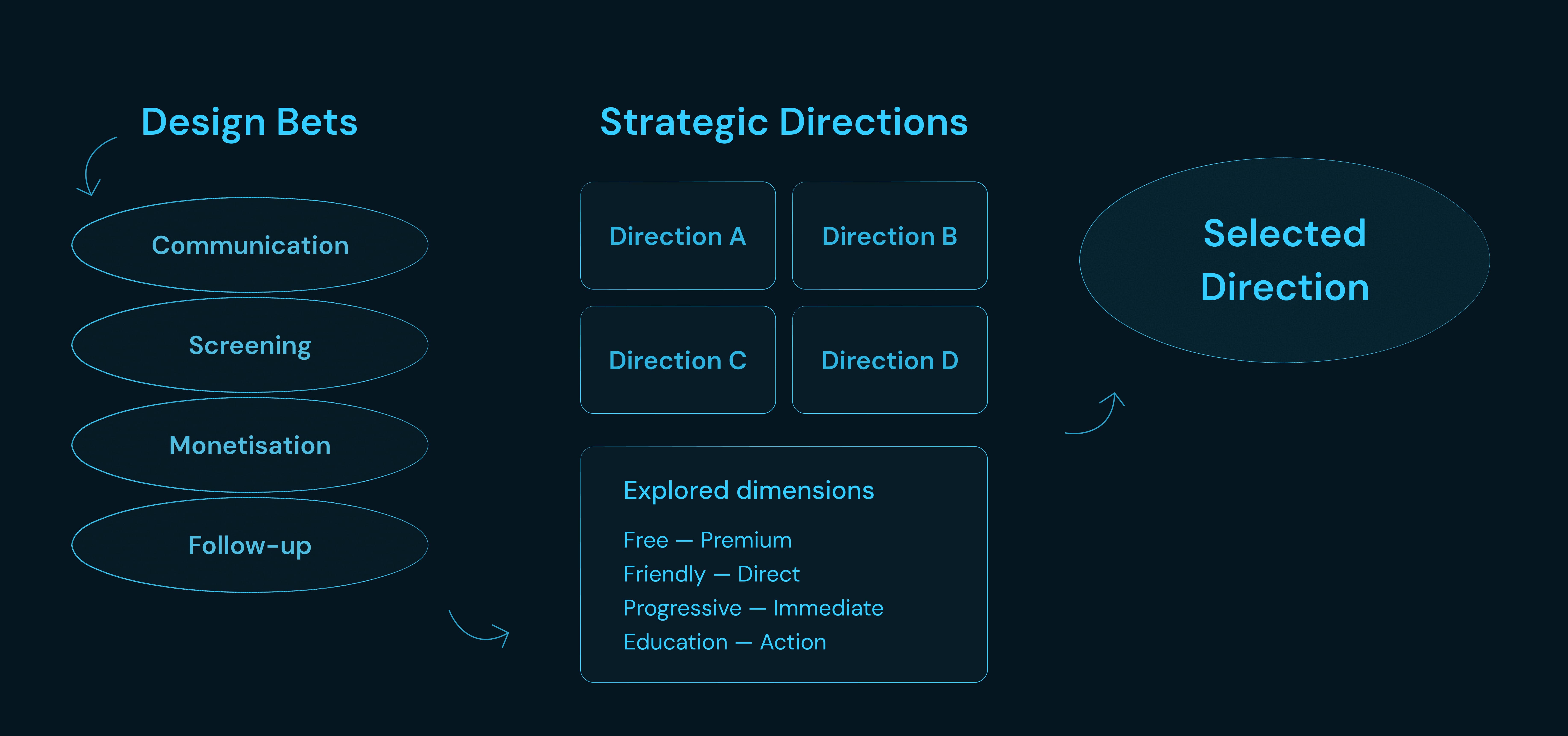
A key part of my role was translating product, sleep research, technical constraints and regulatory requirements into shared design artefacts.
Rather than committing early to one direction, we explored multiple design bets across communication, screening, engagement, follow-up and commercial models. Each concept helped make trade-offs tangible and moved discussions from opinion to concrete system behavior.
Key design areas
System states & edge cases
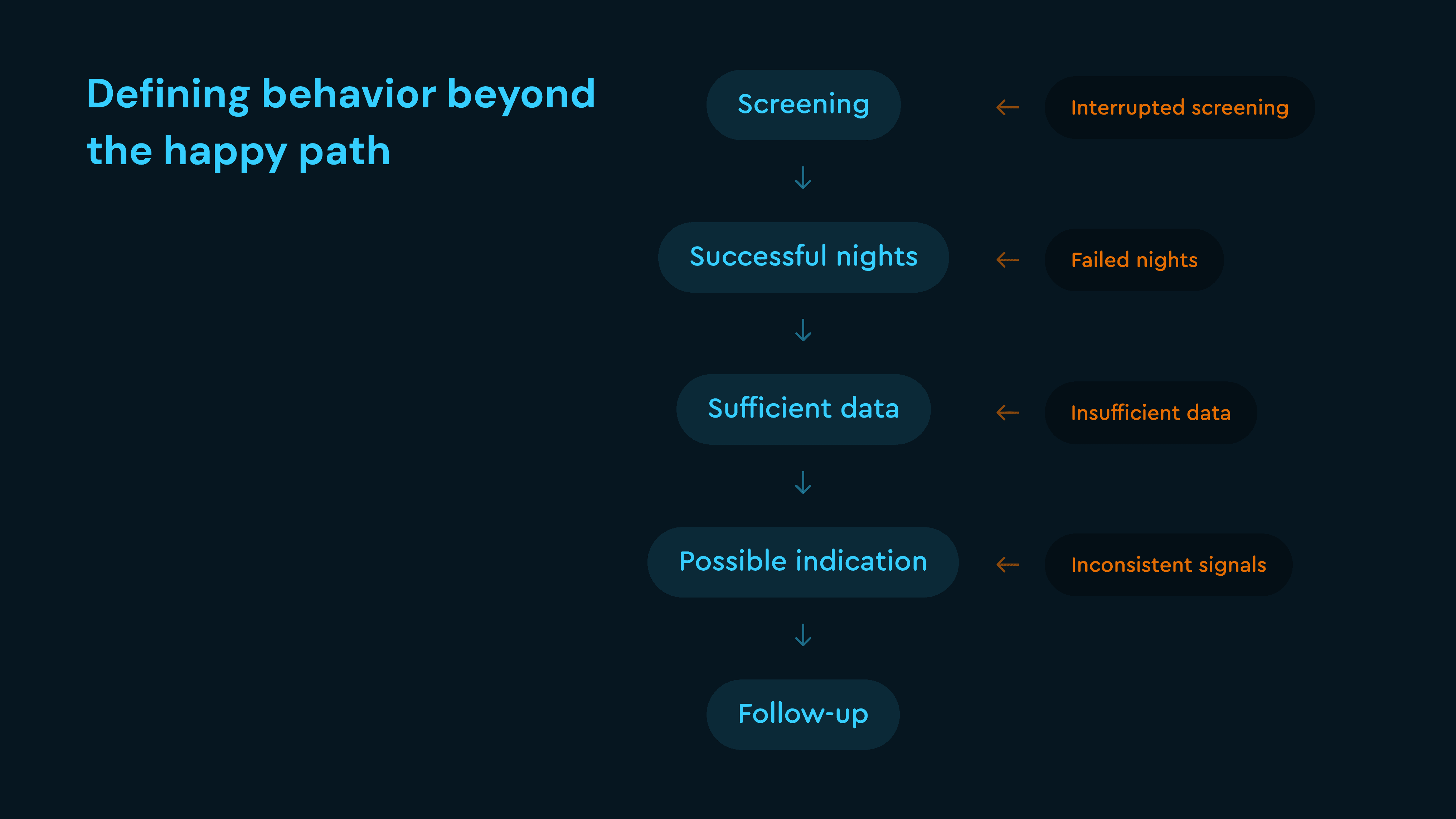
Rather than focusing solely on ideal outcomes, we defined how the system should respond to failed recordings, incomplete datasets, inconsistent signals and interrupted screening periods. These edge cases became essential parts of the experience rather than exceptions.
Communicating uncertainty
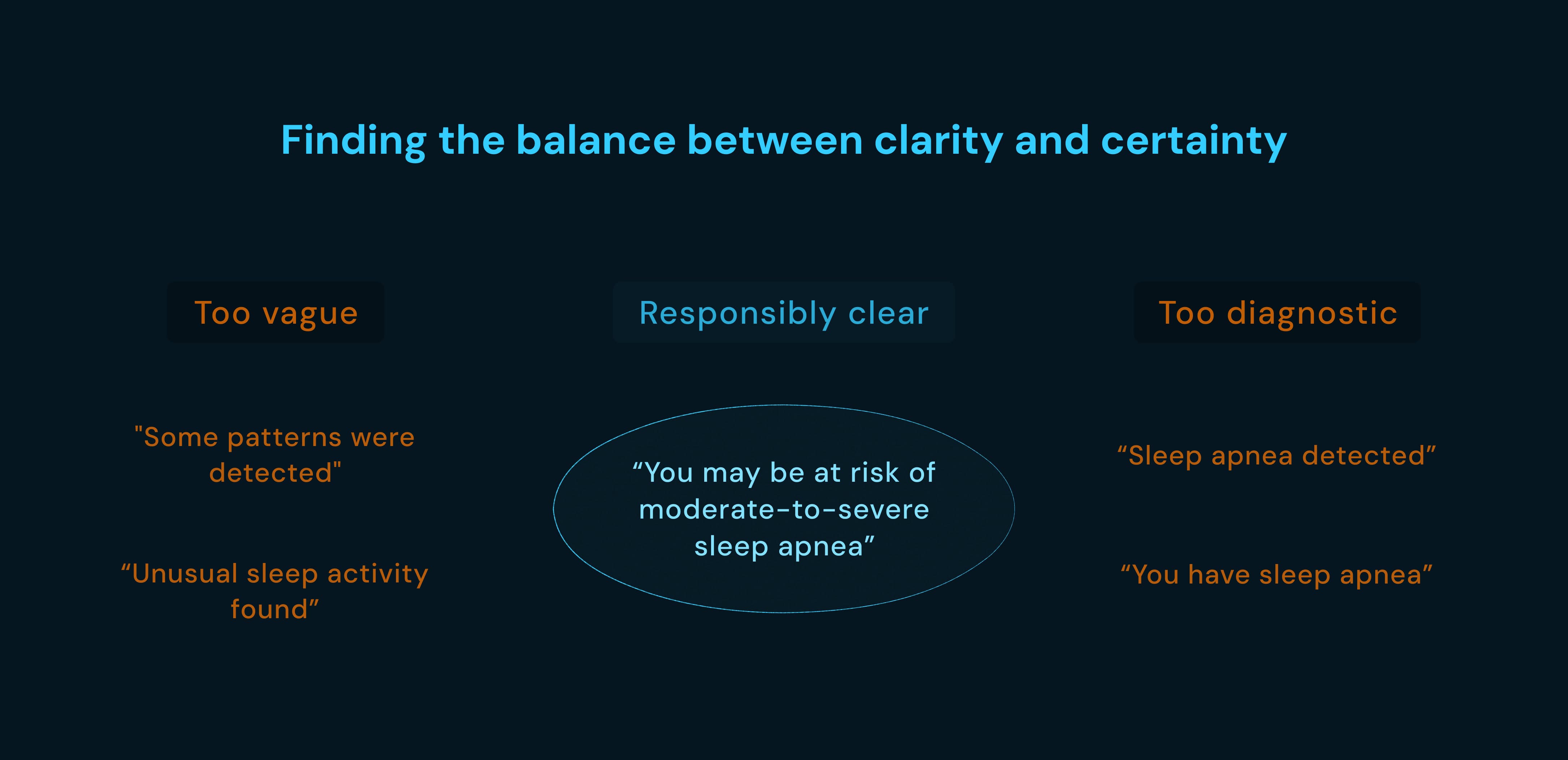
One of the central design challenges was helping users understand potential risk without implying diagnosis. We explored how language, framing and system feedback could remain actionable and trustworthy while staying within regulatory boundaries.
"The FDA will want us to inform the user as soon as we can."
Head of Sleep Science
Sleep Cycle
Guiding users from awareness to action
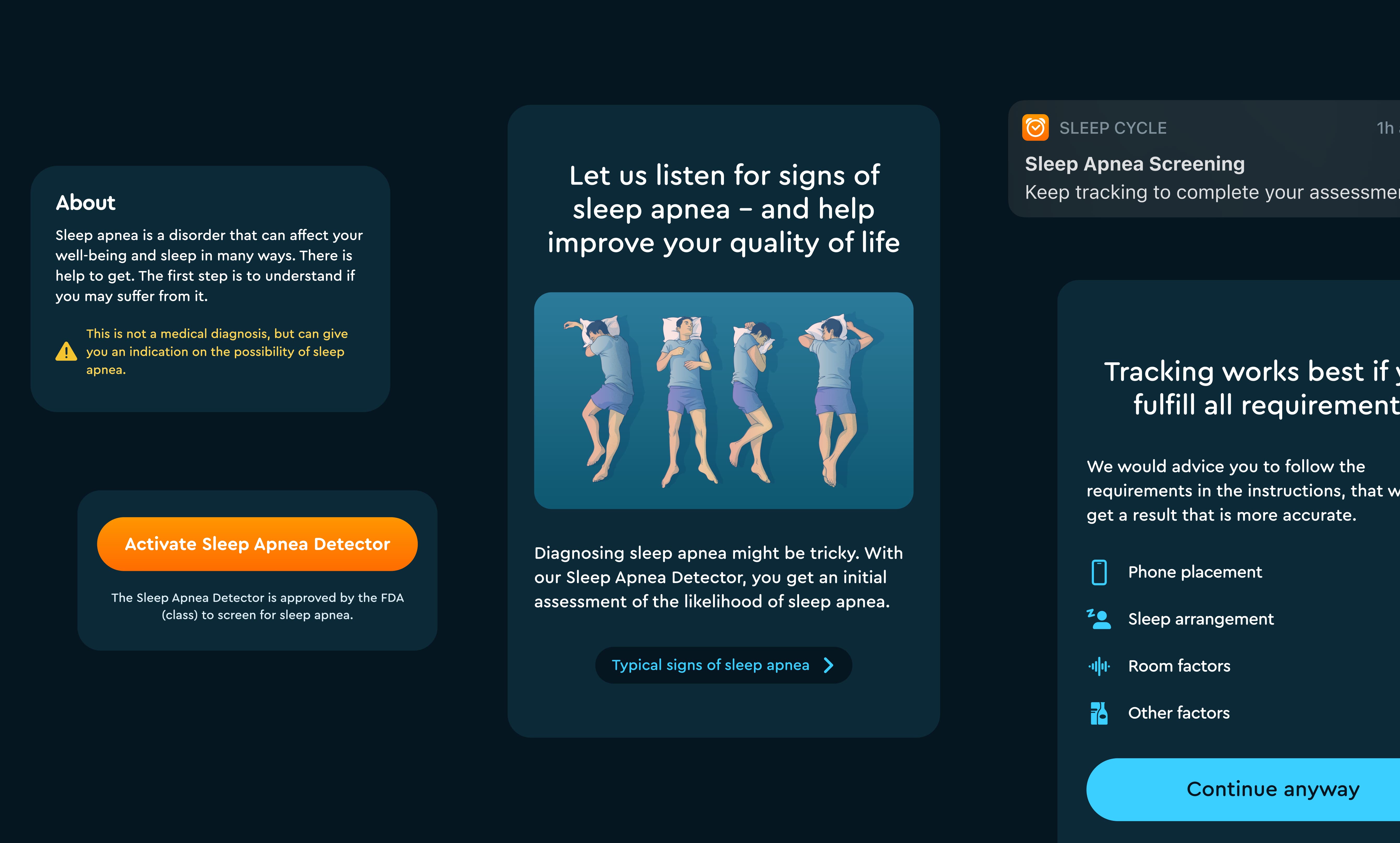
Rather than presenting sleep apnea as a single feature, the experience gradually introduced awareness, education, activation and guidance. Each touchpoint had a specific role in helping users understand why screening mattered, what to expect, and how to complete it successfully.
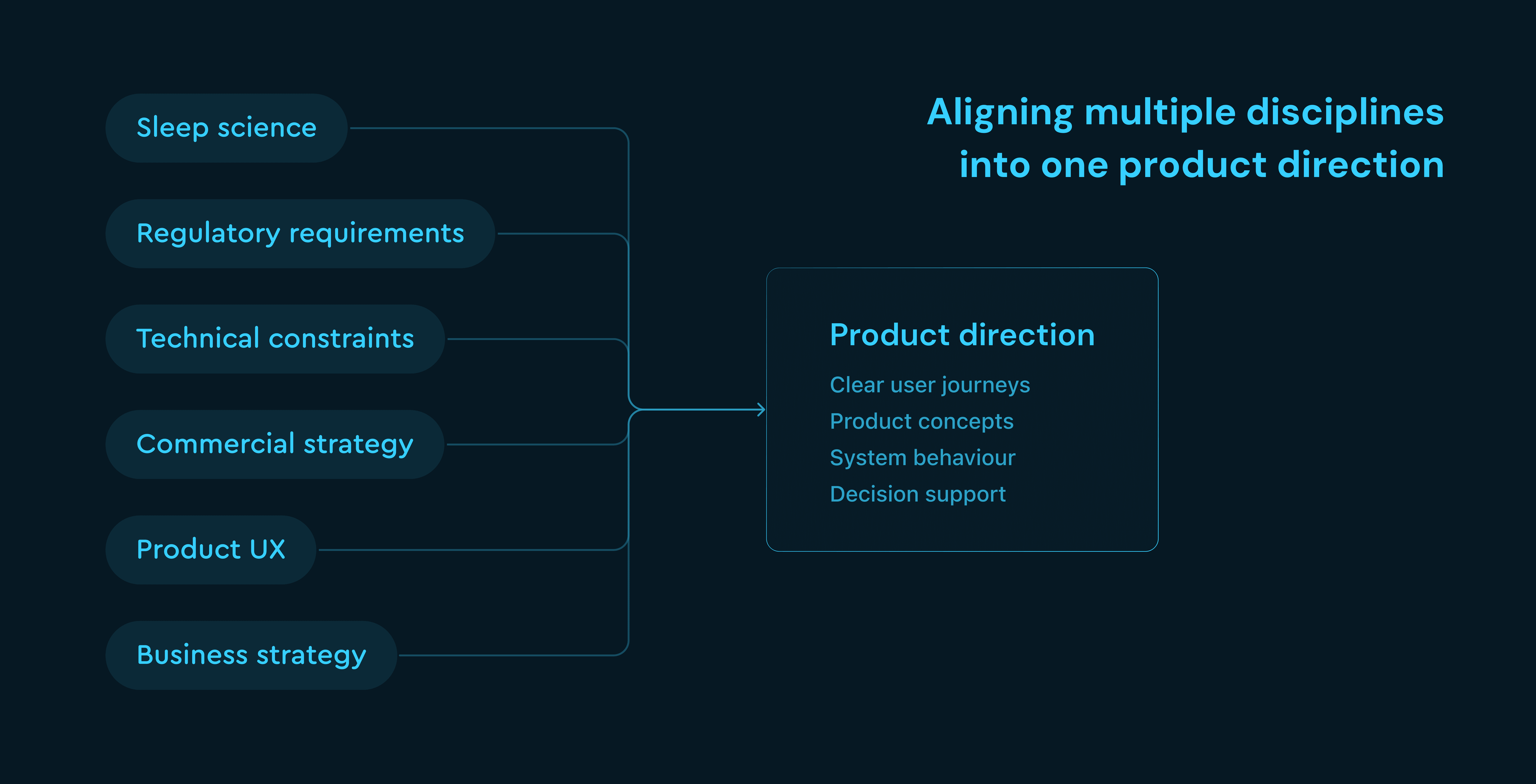
Turning complexity into shared direction
The work required alignment across sleep science, regulatory requirements, technical constraints, product UX, commercial strategy and broader business goals.
Rather than one domain leading, my role was to help translate cross-functional input into shared design artefacts — including flows, product concepts, system logic and decision frameworks.
This made clarity, structure and iteration essential parts of the design process itself.
Laying the foundation for production
The work helped establish a clearer system-level direction for the screening experience, including how different outcomes and uncertainty states should be handled.
It also contributed to moving the work toward a production-ready direction, where flows and edge cases were sufficiently defined for implementation discussions.
Internally, it helped accelerate alignment by making a complex space concrete through prototypes and system definitions. A foundation for future production work.
“Everything worked seamlessly, from clear sketches and well-reasoned arguments to iterations and refinements. From idea to execution, feedback and refinement, Hannah brings a level of independence and drive that is rare even among others at a similar level in the industry.”
Andreas Roman
Former Head of Product, Sleep Cycle
Thoughts moving forward
This project reinforced that designing in regulated, medically adjacent contexts is less about linear flows and more about shaping systems that can hold uncertainty.
A large part of the work was about creating structure where certainty does not fully exist yet - while ensuring the user experience remains calm, honest, and usable.
Read more about the project:
Apnea risk detector:
The Future of Sleep Apnea Screening ↗
Powered by Sleep Cycle:
Sleep Apnea Risk Detection, Simplified ↗
Sleep Cycle News, 2 June 2025:
Sleep Cycle Launches Clinical Study for AI-Powered Sleep Apnea Screening, Targeting a Billion-Dollar Market ↗
Some photography sourced from Unsplash, and last image from Sleep Cycle.
